
A Complete CRM Development Guide for Businesses in 2026
In fact, today’s businesses are drowning in customer data. What they find are more like disjointed systems, broken conversations, missed follow-ups and, well, some pretty bad customer experiences. This is why CRM software is such a business-critical thing, even if people don’t say it out loud.
Businesses across various sectors are investing in intelligent customer relationship management platforms in 2026 to streamline operations, boost customer engagement, automate routine workflows, and yes, drive revenue growth. But off-the-shelf CRM tools still don’t fit very often. They don’t have unique business needs, industry-specific workflows, or the kind of scaling pains you start to feel later.
So nowadays organizations are moving to custom CRM solutions that are built with their must needed specific operational goals.
Businesses should hire a reputable software development company to build scalable and secure CRM systems that align with their long-term digital transformation plans. We see every day that tailored CRM systems are revolutionizing how companies manage customer relationships. They span from lead management and sales automation to customer insights powered by AI.
The guide explains what Custom CRM Software Development Service, its benefits, key features, the development process, use cases across different industries, common challenges, costs, and what future trends are likely to look like.
Understanding CRM Software Development
More or less Customer Relationship Management (CRM) software is meant to help organizations manage their relationships with leads, clients, suppliers and business partners from one main place or centralized platform.
CRM software development, on the other hand, is all about the whole process of designing, building, connecting and continuing to maintain those CRM platforms, specifically tweaked to what a given business actually needs.
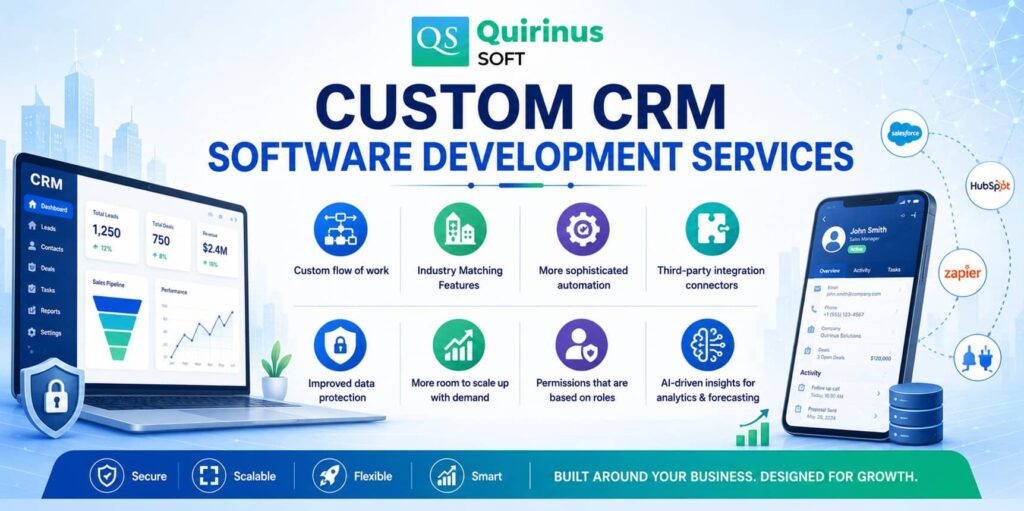
And unlike standard or off-the-shelf CRM tools, these customizations usually provide things like
| ✅ Custom flow of work | ✅ Industry Matching Features |
| ✅ More sophisticated automation | ✅ Third-party integration connectors |
| ✅ Improved data protection | ✅ More room to scale up with demand |
| ✅ Permissions that are based on roles | ✅ AI-driven insights for analytics & forecasting |
So when companies put money into a tailored CRM platform, they usually end up with better command over customer journeys, sales pipelines, and everyday operational efficiency.
Why Businesses Need CRM Software in 2026
Customer expectations keep shifting pretty quickly, like fast, too. Buyers now want a sort of tailored experience; they want instant replies, and they want support that feels smooth across multiple channels, no stalling.
The day-to-day business operations just don’t work with old-school spreadsheets and scattered tools anymore.
These are some of the biggest reasons companies are moving towards CRM systems in 2026, even if the change seems like a lot at first.
1. Centralized Customer Data Management
A CRM platform stores customer data, purchase history, message records, preferences, and past interactions in one secure location.
So teams can get the right information immediately, without jumping back and forth between several tools.
2. Improved Sales Performance
Sales teams can more efficiently chase leads and run automated follow-ups. They need to monitor the pipeline and focus attention on the most valuable prospects.
CRM systems also remove the grunt work, the kind that eats up time. So, reps will spend more of their time on conversions and less on paperwork.
3. Better Customer Retention
Organizations can raise satisfaction by sending customized communication, responding faster, and reaching out more proactively.
It’s easier to keep customers for the long haul when teams really understand customer behavior and those little preference patterns.
4. Workflow Automation
Automation allows you to eliminate the repetitive tasks like timing emails, routing leads, making invoices and updating progress.
That boosts productivity and also lowers the chance of human mistakes, which is kind of the point.
5. Decision Making Based on Data
More sophisticated reporting and analytics enable organizations to measure outcomes, project revenue, identify bottlenecks sooner and optimize their acquisition efforts.
It basically turns guesswork into something closer to clarity, even when the market is a mess.
Key Types of CRM Solutions Businesses Use
Different organizations require different types of CRM systems, mainly because their business goals are kinda different, you know. Some like speed, some like analysis, some just want better back and forth between the teams.
Operational CRM
Operational CRM is more focused on automating the mundane, day-to-day tasks, like day-to-day business processes, e.g.
- Managing Sales
- Customer support
- Automated marketing
- Nurturing the lead
- Perform Tasks
A CRM like this tends to make things run more smoothly and efficiency is increased in all departments even those that were “slow” before.
Analytical CRM
Analytical CRM systems are all about collecting and then sorting through customer data and then making it useful. These platforms help a business:
- Understand the customer behaviour better
- Forecast purchasing trends
- See how the campaigns really performed
- Better customer segmentation
- Not just charts, but turn raw numbers into insights you can act on
Collaborative CRM
Collaborative CRM is more about cooperation and communication across departments. This makes it so that sales, marketing and support teams can see the same customer information and work together better without having to pass the same notes back and forth over and over again.
Industry-Specific CRM
Today, many companies prefer vertical or industry-specific CRM systems that should be customized for industries like;
- Health
- Property Management
- Finance
- Retail
- Academic History
- Logistics
- Production
- Travel
- Insurance
With these customized solutions it comes with dedicated workflows and compliance support, so you don’t have to make generic tools fit the bill.
Modern CRM Software: Essential Features
A successful CRM platform should include features that improve customer engagement, operational efficiency and business intelligence.
- Contact Management: The system will hold complete customer profiles, communication histories, documents, and interaction timelines.
- Lead Management: Lead tracking tools make it easy for businesses to collect, organize, assign and nurture potential customers efficiently.
- Managing the Sales Pipeline: Sales managers can monitor deal progress, conversion stages, and revenue forecasts through visual dashboards.
- Automated marketing: CRM platforms can automate email campaigns, social media communication, and audience Visual dashboards enable sales managers to track deal status.
- Workflow Automation: Automation tools simplify repetitive tasks such as reminders, approvals, follow-ups, and notifications.
- Reporting and Analytics: Advanced dashboards provide insights into:
- Sales performance
- Customer engagement
- Campaign ROI
- Team productivity
- Revenue trends
- Mobile Accessibility: Mobile-friendly CRM applications allow teams to access customer information anytime and anywhere.
- AI-Powered Insights: Artificial intelligence can help businesses predict customer behavior, recommend actions, automate communication, and improve personalization.
- Third-Party Integrations: Modern CRM systems often integrate with:
- ERP software
- Payment gateways
- Accounting tools
- Email platforms
- Customer support tools
- E-commerce platforms
- Communication software
Benefits of Custom CRM Software Development Services
Businesses can outgrow generic CRM tools rather fast because they’re kinda stuck with limited flexibility and scalability, and at some point it feels like you’re fighting the software instead of using it. That’s kinda why more organizations are putting money into tailored CRM development services, so things actually match how they work.
Personalized Business Workflows
Custom platforms are shaped around the exact operational structure of the business. That usually means smoother processes, less friction, and better day to day efficiency, even if teams are doing slightly different things than the “standard” setup.
Enhanced Scalability
A custom CRM system can grow with your company. You can add new modules, more users, add integrations and unlock advanced functionality without major downtime or disruptions that make everyone nervous.
More Secure
A dedicated CRM solution provides you with more direct control over data protection, compliance requirements and user permissions. This is especially true for industries that deal with sensitive customer information where mistakes simply cannot be made.
Better Integration Capabilities
Custom CRMs can be customized to integrate better with existing tools. This means less data silos and more operational visibility across teams, something that generic tools often have trouble with.
Better User Experience
Rather than forcing employees into the platform, companies can build interfaces into actual employee workflows and paths of customer interaction. Usually it feels more natural and adoption gets better.
Competitive Edge
A custom CRM can provide features and functionality that off-the-shelf platforms simply can’t, or would require expensive work-arounds to achieve. This actually helps businesses to differentiate and compete more effectively in busy markets.
CRM Software Development Process
Building a successful CRM platform requires a structured approach. This is the standard procedure followed by an experienced software development company.
1. Examine business requirements
Stage one is about comprehension:
- Business objectives
- Problems in customer management
- Workflow requirements
- Needs for integration
- Regulatory Compliance
- User expectations
This stage helps define the project scope.
2. CRM Strategy Design
The development team develops a roadmap which includes:
- Functions
- Technological stack
- Designs
- Time Line
- Budgeting
- Security approach
3. Design UI/UX
User experience has a huge impact on CRM adoption.
Intuitive dashboards, workflows and mobile friendly interfaces are created so that navigation is smooth.
4. Backend and Frontend Development
Developers build the core system architecture, APIs, database structure, and user-facing interfaces.
5. Integration Development
The CRM system is integrated with third-party tools such as ERP platforms, payment systems, cloud storage, and communication tools.
6. Testing and Quality Assurance
The platform undergoes:
- Functional testing
- Security testing
- Performance testing
- Compatibility testing
- Usability tests
This keeps the CRM running smoothly.
7. Deployment & Release
When testing is successful, the CRM platform is deployed on production servers or cloud environments.
8. Support and Maintenance
Maintenance after launch includes
- Security patches
- Optimization of performance
- Feature improvements
- Technical Help
- Corrections
Industries Benefiting from CRM Development Solutions
CRM systems aren’t just for huge enterprises anymore, like they used to be. A lot of businesses in different industries are now turning to CRM platforms so they can smooth up daily operations and also improve customer experiences, kind of end-to-end.
Challenges Faced by Businesses Without an Effective CRM System
Many orgs still use disconnected tools like spreadsheets, or old school software. And yes, this kind of thing can really give you operational headaches.
Disorganized Customer Data
Information about customers ends up spread across different departments, so you get communication gaps, and some chances just disappear.
Low Team Productivity
Team members end up spending extra time on manual work and repeat cycles, instead of doing anything more meaningful.
Poor Customer Experience
Slow replies, plus messaging that feels inconsistent, can really drag customer satisfaction down.
No Business Insights
Analytics are the best way to track customer behaviors and identify trends in performance over time.
Scalability limited
Old systems usually can’t scale smoothly so growth becomes a slog and not a simple step forward.
Challenges in CRM Development and Their Solutions
Making a high-performing CRM platform can get messy, in both tech and day to day operations, there are always some complexities.
Below are a few usual pain points businesses bump into, and the way expert developers kind of handle them, in a very practical way.
Challenge: Integration Complexity
Companies often juggle several tools in different departments, and it gets a bit chaotic.
Solution
Professional development teams typically lean on API-driven architecture, so everything connects cleanly with third-party platforms without all the awkward hand offs.
Challenge: User Adoption Issues
Employees sometimes don’t want to switch, or they just need more time to get comfortable.
Solution
A friendly interface, focused employee training, and streamlined workflows tend to raise adoption levels quickly.
Challenge: Data Security Risks
CRM systems hold sensitive customer info, so one slip and it can become serious fast.
Solution
They usually implement strong encryption, role-based access control, plus a compliance-oriented architecture to tighten up data protection.
Issue: Scalability Problems
Sometimes the setup doesn’t quite scale as the business expands.
Solution
Cloud-native, modular CRM design helps organizations scale without performance becoming a roadblock.
Challenge: Costly Maintenance
If systems are poorly built, the fixes start to stack up and the costs start to rise.
Solution
Experienced developers use scalable frameworks and clean code which reduces the cost of maintenance in the long run.
Latest CRM Development Trends in 2026
CRM technology is moving full steam ahead, with AI, automation and cloud computing that sort of change how teams do things day to day.
Customer Intelligence from AI
AI algorithms assist companies with predicting customer behavior, spotting sales opportunities and handling automated outreach, perhaps more efficiently than ever.
Voice-Enabled CRM Software
Voice assistants make things easier, and they make CRM navigation simpler, even when you’re multitasking.
Hyper Personalization
Nowadays many businesses are delivering hyper-personalized experiences. That is powered by behavioral analytics and real-time customer signals.
Cloud-based CRM systems
In this industry cloud infrastructure brings better scaling, easier access, and cost effectiveness that doesn’t feel like a mystery.
Omnichannel Customer Engagement
Modern CRM tools can coordinate communication throughout
- Email:
- Social networking sites
- Live chat
- Messaging applications
- Telephone Exchanges
Low-Code and No-Code CRM
Some organizations choose low code development for quicker process customization, but for more complex businesses, they generally opt for fully customized CRM for flexibility and advanced capabilities.
How to Choose the Right CRM Development Partner
Choosing the right technology partner is, critical for project success even if it seems obvious on paper. Businesses really should look at several things first, before hiring a CRM development company, because skipping steps can get messy.
Industry Experience
Go with a firm that shows clear know-how in creating CRM platforms for your specific sector, not just “similar” work.
Technical Expertise
The team should have hands on experience with things like
- Cloud technologies
- AI integration
- API development
- Mobile app development
- Cybersecurity
- Database architecture
Customization Capability
Make sure they can craft tailored workflows and features instead of leaning on rigid templates, every time. You want flexible, pragmatic adjustments, not a one-size-fits-all approach.
Communication & Support
Good communication during the build and dependable post-launch support are critical. If they are vague now, it generally gets worse later.
Clients Portfolio
Check out their previous works, case studies, and client reviews. This allows you to assess quality of development and of delivery in real-life situations.
Estimated CRM Software Development Cost in 2026
The costs vary depending on project complexity, features and integrations.
Here is a general cost estimate.
| CRM Type | Estimated Cost |
|---|---|
| Basic CRM Solution | $10,000 – $25,000 |
| Mid-Level CRM Platform | $25,000 – $60,000 |
| Enterprise CRM System | $60,000 – $150,000+ |
A bunch of factors affecting development cost would include things like the Number of features, plus third party integrations, and the way AI capabilities are set up. Then cloud infrastructure, mobile compatibility plus security requirements, also tend to matter. Even team size, and the development timeline can swing the total.
Businesses should probably prioritize long term value, rather than only staring at the initial development expenses.
Why Businesses Prefer Custom CRM Development Over Ready-Made Software
Many organizations start with off-the-shelf CRM tools because there is less upfront cost. And yet, as operations expand, business seems to hit limits and the same old setup begins to feel a little confining. In that case, custom-built CRM systems can bring a bunch of benefits, like more flexibility, stronger scaling, better overall performance, and heightened security.
You also get industry-specific tuning and smoother integration, plus in the long run the costs stay kinder than repeated workarounds. In the end a tailored platform just keeps pace with business growth instead of making the business keep reshaping its day-to-day workflows.
Future of CRM Software Development
You know, CRM systems are going to keep evolving way past the old-school customer management thing. In the years ahead, businesses will experience a host of changes, such as predictive customer engagement that’s a bit more proactive than before, AI-driven automation that takes care of routine tasks without much fuss; and real-time analytics that surface what’s happening right now. Also, smart chatbots will be more conversational and emotion-based customer insights will attempt to read customer sentiment in a more subtle manner.
You will see advanced workflow coordination and deeper omnichannel integration across channels that used to feel disparate. Many organizations that begin investing in scalable CRM ecosystems today will have much stronger competitive advantages in upcoming time.