
Are you looking for the top e-commerce platforms that can match the 2026 online retail experience? If yes, you are at the right place. These days, launching a store is not just listing your products. You need to bring a seamless experience across multiple devices and social media feeds. Especially when AI is rapidly entering the market, you have to check a future-proof AI-ready platform too, for your users’ convenience.
Here you will find the top 10 leading e-commerce platforms for 2026. Let’s check.
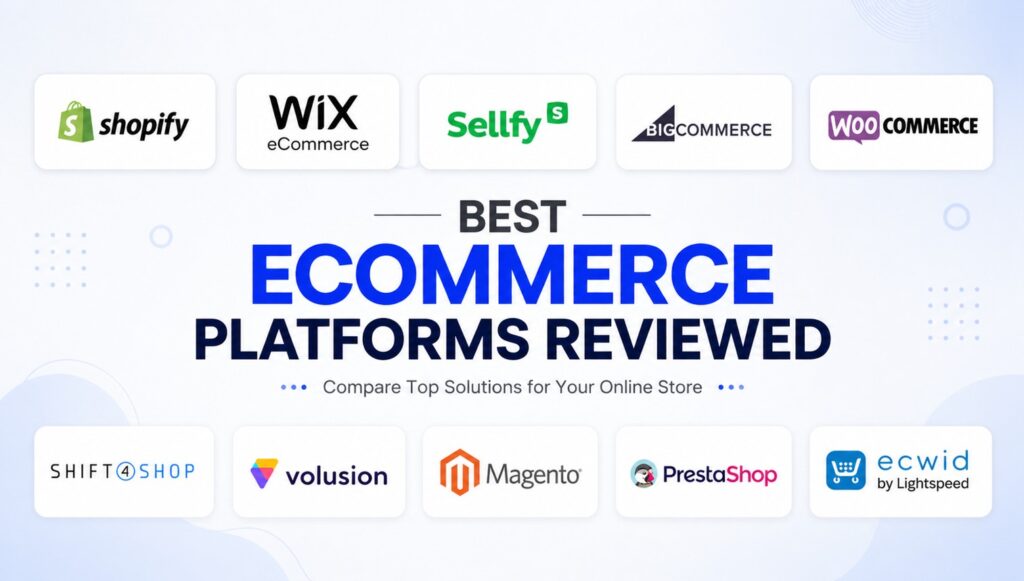
Top 10 E-commerce Platforms in 2026
1. Shopify
Shopify is the number one choice for people who want to sell things. It takes care of the stuff like hosting and security, so you can focus on selling your products. Shopify is great for people who want a looking store that works perfectly from the very beginning.
- Main features: Infinite product listings, abandoned cart recovery, seamless integration of Shopify Payments, and a mobile app to manage your business anytime, anywhere.
- Pros: Almost perfect uptime, the biggest app market in the industry, and friendly, helpful customer support is always on hand.
- Cons: Monthly subscription fees are climbing up with more added apps, and you have to pay the transaction fees if you don’t use their internal payment system.
2. Wix eCommerce
Wix is specially designed for creative business owners. If you already have a vision for your e-commerce platform, Wix can be the right partner for you. The drag-and-drop editor on Wix gives you a lot of freedom to make changes. It offers more flexibility than many other platforms out there.
- Key Features: Visual “What You See Is What You Get” editor, AI-driven site creation, integrated blog tools, and built-in video capabilities for product showcases.
- Pros: Extremely easy for beginners, top-quality templates, and comes with hosting and a free domain for the first year.
- Cons: Changing to a new template after launching your site is not straightforward, and uploading many high-resolution images might slow down the website.
3. BigCommerce
BigCommerce is a tool for really serious sellers, about what they do. It gives BigCommerce users all the tools they need to get started with BigCommerce away, so they do not have to spend extra money on other apps for their BigCommerce store.
- Key Features: Full native support for multiple currencies, detailed SEO controls, selling across different platforms (Facebook, Pinterest, Walmart), and an extensive API available for developers.
- Pros: There are no transaction fees on any subscription, the platform is designed to accommodate large increases in traffic without faltering, and a lot of “Pro” features are offered at no additional cost.
- Cons: It is more challenging for newbies as the learning curve is steeper, and if your yearly sales exceed a certain amount, they will force you into a more expensive plan.
4. Sellfy
Sellfy is a simple platform. The platform is made for people who do not want to spend a lot of time on website development. Sellfy is the way to get a digital shop or a print-on-demand shop online. You can get started with Sellfy quickly.
- Key Features: Immediately deliver digital products, offer print-on-demand in-house, promote with email marketing, and “Buy Now” buttons work on social media.
- Pros: It only takes 10 minutes to get started. No secret transaction charges. A very neat user interface.
- Cons: Limited customization for traditional retail brands. Also, fewer third-party integrations than Shopify.
5. Volusion
Volusion is a platform that you can really count on. It has been helping businesses sell things for a long time. It mainly works on the data behind your sales to help you understand your customers better.
- Key Features: User-friendly “step-by-step” store builder, inventory monitoring, safe payment processing, and a useful analytics dashboard.
- Pros: The backend is very neat and structured, the onboarding of new sellers is very supportive, and no transaction fees.
- Cons: You can’t sell digital products there, and the size of its app store is quite small compared to the competitors.
6. Shift4Shop
Shift4Shop is for businesses that want lots of features without spending much. It is a powerful platform that does almost everything and is often not noticed.
- Key Features: Integrated loyalty systems, comprehensive stock control, advanced SEO functionalities, plus a complimentary “End-to-End” plan for merchants in the US.
- Pros: Super affordable for US vendors, equipped with more functionalities than Shopify’s basic plan, and the tech support is excellent.
- Cons: The design of the store templates is a little dated, and compared to Wix or Shopify, the backend user experience is less fluid.
7. WooCommerce
WooCommerce is for people who want to own their store. It is a WordPress plugin. This means you have control over your data. You also control the design and costs of your store.
- Key Features: There are thousands of themes that you can customize, Yoast helps you with SEO integration at a deep level, shipping calculators are very flexible, and there is a huge developer community.
- Pros: The software is free, it has the most advanced blogging features, and you may literally edit every piece of code.
- Cons: You will have to take care of your own security, hosting, and software updating, which may be a source of stress if you are not technically gifted.
8. Ecwid
Ecwid is like a store that you can easily add to your existing website. You do not need to create a new website. Just add Ecwid to your website, blog, or Facebook page.
- Key Features: Mirroring technology (syncing across all sites), mobile POS integration, automated Google and Facebook ads, and a “forever free” plan.
- Pros: Adding a shop to an existing site couldn’t be easier. Very affordable, and mobile phones work flawlessly.
- Cons: Doesn’t work well if you want to create a huge brand with only your e-commerce site, and the checkout page doesn’t have many design options.
9. PrestaShop
PrestaShop is a European platform with simple usage. It gives you the power of an open-source tool.
- Key Features: More than 75 languages are supported, modular features, one-page checkout, and a robust international online community.
- Pros: The main software is free, it’s excellent for global sales, and you have the option of picking from thousands of premium modules.
- Cons: You might need to buy pricey modules even for some “basic” features, and you have to pay for your own hosting.
10. Magento
For companies with complicated requirements, Magento, also known as Adobe Commerce, is the best choice. It manages a lot of visitors and detailed product lists that smaller platforms can’t handle well.
- Key Features: Sophisticated customer segmentation, professional-level B2B features, unlimited product attributes, and multi-site administration from a single dashboard.
- Pros: Truly “unlimited” capability and rugged enough to manage millions of dollars in sales daily without any hiccup.
- Cons: The installation costs are sky-high, and periodic maintenance by a developer or agency is a must for the safety of the platform.
Which platform is best for SEO in 2026?
WooCommerce is the top choice because it runs on WordPress. It provides the most granular control over technical site structure and content.
Do I need coding skills to start?
No, platforms like Shopify and Wix offer drag-and-drop builders. You only need coding for advanced customization on platforms like Magento or WooCommerce.
Can I sell on social media?
Yes, most platforms like Ecwid and Shopify sync directly with TikTok and Instagram. This allows customers to purchase products without ever leaving their favorite apps.
What is the cheapest way to start?
Ecwid offers a “Free Forever” plan for small inventories. Shift4Shop also provides a powerful free tier if you use their specific payment processor.
Is it easy to switch platforms later?
You can export product data via CSV files to new platforms. However, you will usually need to rebuild your website’s visual design from scratch.